NATO's Push for War: Why Britain Needs an Exit
As the EU accelerates military integration and the US steps back, Britain faces a choice it cannot avoid.
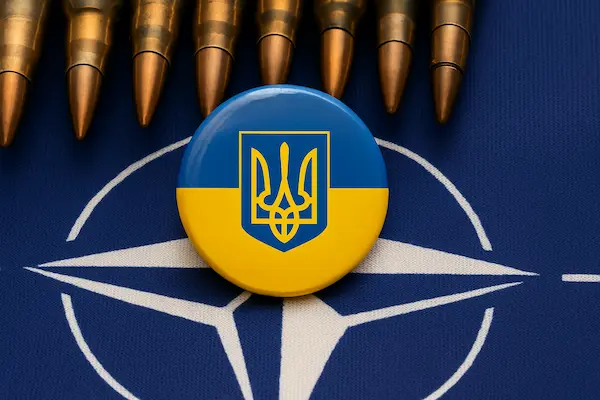
Something remarkable is happening in transatlantic relations. As the United States shifts toward ending the war in Ukraine and pursuing cooperation with Russia, European leaders are escalating their rhetoric and military commitments. Europe is more hawkish now than when Russian armoured columns were advancing on Kyiv. This is not a coincidence. It reveals the true nature of Europe's stake in this conflict - and why Britain must chart a different course.
Europe's Existential Stake
For European Union leadership, Ukraine is not merely a foreign policy concern. It is an existential test of the European project itself. The EU's destiny has become inextricably bound to Ukraine's fate - the credibility of its soft power in drawing nations into the European orbit, the relevance of its emerging hard power in constraining Russian action, the very legitimacy of Brussels as a serious geopolitical actor.
This explains the paradox of European escalation amid American de-escalation. As Washington signals a potential departure from the conflict, Brussels cannot afford to let Ukraine fall. To do so would expose the fundamental weakness at the heart of the European project: that for all its bureaucratic apparatus, it lacks the independent military capacity to shape events on its own continent.
The Accelerating Union
The prospect of American withdrawal from NATO - or even a significantly reduced commitment - has triggered exactly the response that EU federalists have long desired: accelerated military integration. Defence budgets are expanding. Conscription is returning to political discourse. Talk of European armies and shared nuclear deterrents has moved from the fringes to the mainstream.
This is not preparation for defence. It is the forced acceleration of "ever closer union" - a desperate attempt to construct hard power capabilities before the American security umbrella is withdrawn. The EU has long coveted an integrated military force independent of NATO. American retrenchment may finally deliver it.
"Should America depart NATO, the alliance will fracture. What remains will be, in effect, the EU army that Brussels has always wanted - and Britain will face a choice it cannot avoid."
NATO's Coming Fracture
If the United States withdraws from or substantially downgrades its NATO commitment, the alliance will not survive in its current form. Turkey, pursuing its own regional interests, has little reason to remain bound to a European-dominated structure. Canada, facing no credible threat from the Atlantic, may follow. What remains will be a European rump - precisely the integrated EU military force that the project has sought for decades.
A Dangerous Inheritance
This emerging force will inherit the EU's underlying vulnerabilities. As the US National Security Strategy has observed, the bloc maintains unsustainable external dependencies against a backdrop of stagnating economies and demographic decline. These structural weaknesses point toward an existential crisis. Combined with a political establishment that has framed Russia as an existential threat, the conditions are set for dangerous escalation.
A weakening EU, increasingly desperate and ideologically committed to confrontation with Moscow, represents a serious risk of aggravated conflict - one that Britain has no interest in joining.
Britain's Dangerous Position
Britain currently occupies the worst possible position. We are bound by NATO obligations to European security commitments that increasingly serve Franco-German interests rather than British ones. Yet we stand outside the EU decision-making structures that will determine how those commitments evolve. We bear the risks without the influence.
Should current trends continue, Britain faces a grim choice: join a militarising European bloc locked into confrontation with Russia, or stand alone without the American security guarantee that has underpinned our defence since 1945. Neither option serves British interests.
Realigning British Interests
Britain has always been an island nation with global interests. Our history is maritime, commercial, and outward-looking. Today, the European Union's political establishment is steering the continent toward domestic decline and international escalation. America, by contrast, is setting its sights on growth, prosperity, and peace.
Britain's foreign policy must reflect this divergence. We should be aligning our strategic objectives with Washington, not Brussels. That means supporting American efforts to end the war in Ukraine rather than echoing EU demands for escalation. It means prioritising trade and security partnerships across the Atlantic rather than regulatory alignment with a declining bloc. It means recognising that our interests lie with a power pursuing stability, not one careening toward conflict.
As Brussels accelerates toward a confrontation it may need but cannot win, Britain must look westward. The question is not whether the transatlantic relationship will be redefined - it is whether British foreign policy will be on the right side of that redefinition.