Examining the Case for Europe
Examining the case for EU membership - and why it doesn't survive scrutiny.
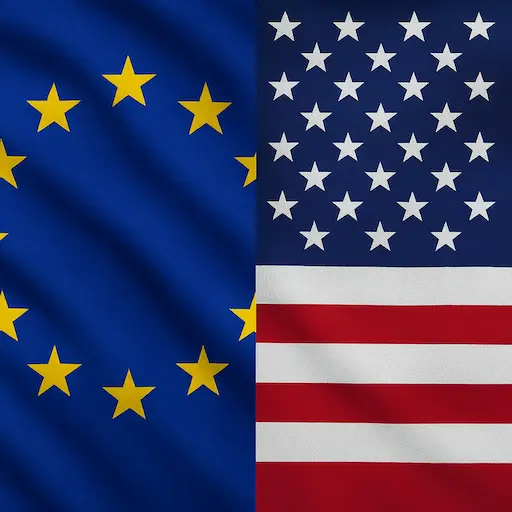
Those who advocate for Britain's return to the European Union make several arguments: access to the single market, collective bargaining power, regulatory standards that protect consumers, and the stability of established institutions. These arguments deserve serious examination - not dismissal, but scrutiny. When subjected to that scrutiny, they reveal more about the EU's limitations than its strengths.
The Single Market Argument
The EU single market is presented as Britain's natural trading home. The geography is obvious; the existing relationships are deep. Yet the numbers tell a different story. The EU share of global GDP has fallen from 31% in 1990 to under 18% today - and continues to decline. The United States alone represents a larger economy than the entire European Union, with substantially higher growth rates and a more dynamic business environment.
More critically, the single market comes with conditions that constrain growth. Regulatory harmonisation means accepting rules designed for 27 different economies with 27 different needs. The EU's precautionary principle - regulating first, innovating later - has systematically disadvantaged European technology, pharmaceutical, and financial services sectors. There is a reason Europe has produced no equivalent to Google, Amazon, or Apple: the regulatory environment selects against the risk-taking that produces such enterprises.
The American market offers scale without strangulation. Fifty states operating under a constitutional framework that permits regulatory competition rather than enforcing harmonisation. States that over-regulate lose businesses to states that don't. The result is a market that rewards innovation rather than compliance - and an economy that has outperformed Europe for three consecutive decades.
The Regulatory Protection Argument
EU supporters argue that Brussels regulations protect consumers, workers, and the environment from exploitation. This framing assumes that regulation equals protection and that more regulation means more protection. Neither assumption survives examination.
European regulations often protect incumbent businesses from competition rather than protecting consumers from harm. GDPR has imposed billions in compliance costs on businesses of all sizes - costs ultimately borne by consumers through higher prices and reduced services. The effect has been to entrench large corporations who can afford compliance departments while crushing smaller competitors who cannot.
"The EU's regulatory framework doesn't protect consumers from corporations. It protects corporations from competition."
The American system takes a different approach: states set their own standards, and consumers choose. California can impose stringent environmental rules; Texas can prioritise business flexibility. Citizens can move between regulatory environments - and do, in their millions. This competition produces genuine accountability. Regulations that impose costs without benefits lose residents and businesses to states with better frameworks. No such mechanism exists in the EU, where regulatory burdens are imposed uniformly and escape is impossible without leaving the bloc entirely.
The Collective Power Argument
Perhaps the most sophisticated EU argument concerns collective bargaining power. Britain alone, the argument goes, cannot negotiate as effectively as a bloc of 450 million people. Better to pool sovereignty and wield influence through Brussels than to stand alone in a world of giants.
This argument confuses size with effectiveness. The EU's collective weight has not prevented it from being sidelined in major geopolitical decisions. The bloc was irrelevant in Afghanistan, divided over Iraq, ineffective in Syria, and dependent on America for the response to Ukraine. On trade, the EU's cumbersome decision-making process - requiring consensus among 27 members with divergent interests - routinely produces lowest-common-denominator outcomes that satisfy no one fully.
American federalism offers genuine collective power without the paralysis. A British state would participate directly in American foreign policy through its congressional delegation - over 85 House members and 2 Senators, making it the largest state by population. This is not diluted influence filtered through Brussels bureaucracy. It is direct representation in the most powerful legislature on earth, with constitutional protections ensuring that British interests cannot simply be overridden by larger partners.
The Sovereignty Question
Critics will note that American statehood also involves pooling sovereignty. This is true but misleading. The nature of that pooling differs fundamentally from the EU model.
EU sovereignty pooling is open-ended and expansionary. The doctrine of "ever closer union" means competencies flow continuously from member states to Brussels. There is no constitutional limit on this transfer - no defined boundary where EU authority ends and national authority begins. The European Court of Justice has consistently ruled in favour of expanding EU power at the expense of member states. The direction is one-way: toward centralisation.
American federalism operates on opposite principles. The Tenth Amendment explicitly reserves to states all powers not specifically granted to the federal government. Federal authority is enumerated and limited. When disputes arise, courts can and do rule against federal overreach. States retain sovereign control over education, criminal law, family law, property law, and most matters affecting daily life. The direction is not toward centralisation but toward balance - enforced by a constitution that both levels of government are bound to respect.
The Direction of Travel
Beyond structural differences lies a more fundamental question: which union is ascending and which is declining? The evidence is not encouraging for the European project.
The EU faces compounding crises: demographic collapse, with most member states below replacement fertility; energy dependence exposed by the Ukraine conflict; industrial decline as manufacturing relocates to lower-cost regions; and a debt burden that constrains fiscal responses to any of these challenges. The political trajectory points toward either disintegration or forced centralisation - neither outcome serving British interests.
The United States, for all its political turbulence, remains the world's largest economy, its reserve currency issuer, its technological leader, and its dominant military power. American dynamism - the capacity for reinvention that has characterised the nation since its founding - shows no sign of exhaustion. The shale revolution, the tech boom, the AI frontier: each wave of innovation emerges from American soil.
The Real Choice
The choice facing Britain is not between independence and membership in a larger bloc. True independence is not available to a mid-sized island economy in an interconnected world. The choice is between blocs - and between different models of what membership means.
The EU offers managed decline within a centralising bureaucracy, governed by consensus among nations with divergent interests, bound by regulations that privilege compliance over innovation, and committed to an "ever closer union" that progressively erases national distinctiveness.
American statehood offers constitutional participation in a dynamic economy, with guaranteed representation, protected sovereignty in domestic affairs, competitive rather than harmonised regulation, and alignment with a nation whose trajectory remains upward.
The arguments for EU membership are arguments for the familiar, for the proximate, for the path of least resistance. They are not arguments for Britain's flourishing. When examined seriously, they reveal a project offering stability only in the sense that decline can be stable - a gentle descent rather than a turbulent one. Britain deserves a better choice than managing its own diminishment. That choice exists, westward across the Atlantic.